

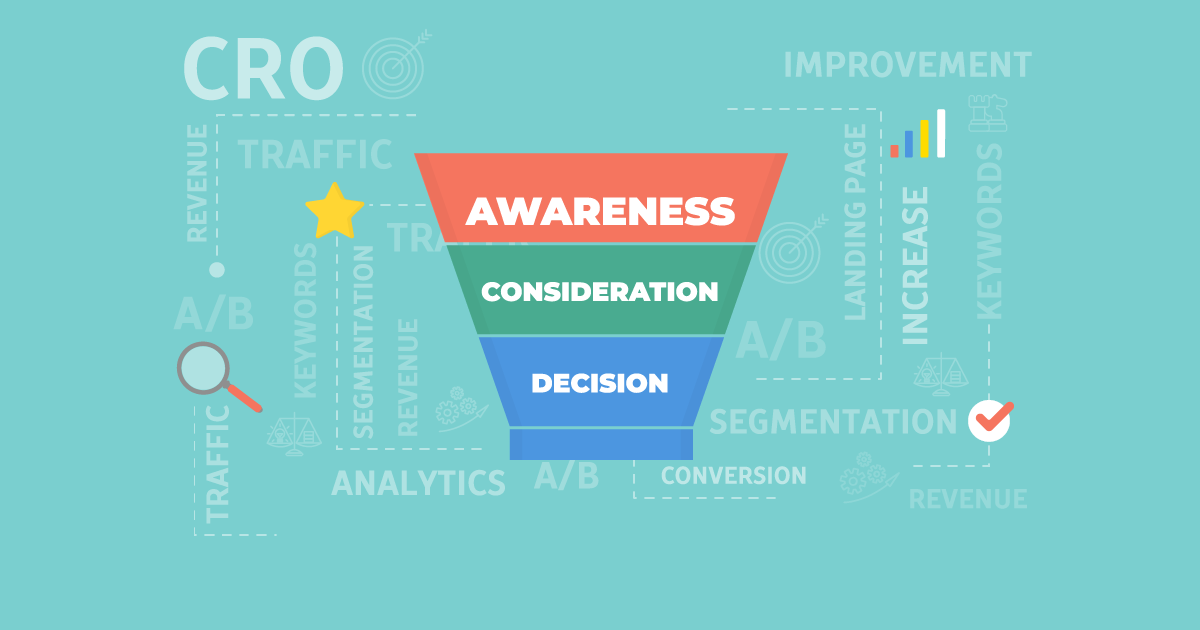
A digital marketing funnel helps you nurture your customer at every stage of their buying journey.
There are three primary stages to a digital marketing funnel – awareness, consideration, and decision.
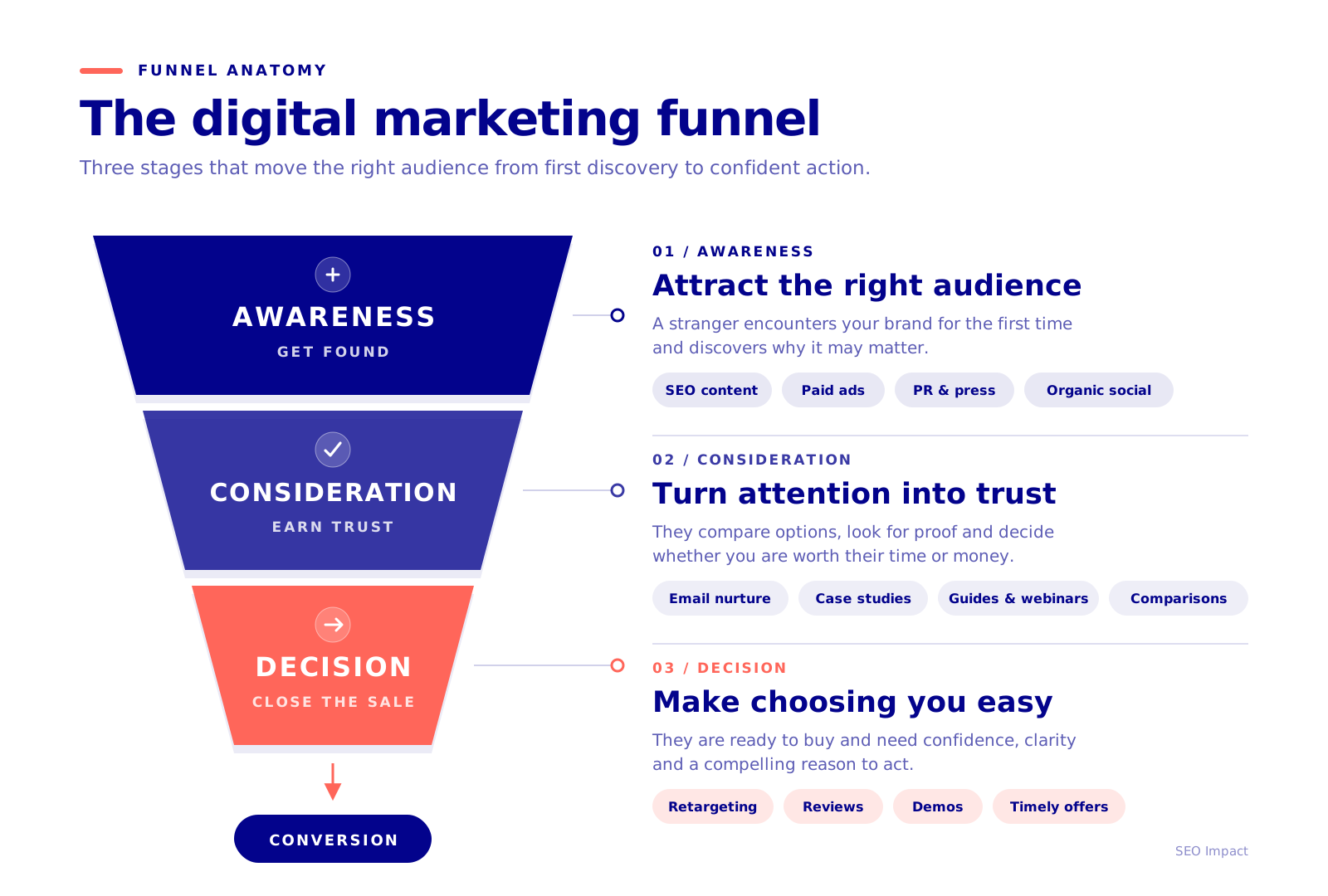
While you might think these are just the natural stages of a purchase, a functional funnel is vital for conversions.
Understanding the funnel that your customers go through is essential. Every audience is different, and the funnel can vary based on their behaviour and your marketing tactics. Understand your customer’s behaviour for a better relationship.
Customers who’ve been nurtured at every step of the funnel can go on to become loyal ambassadors of your brand.
Another useful way to understand how marketing moves customers through this journey is the AIDA model. It describes the response your marketing should encourage at each stage:
- Attention
- Interest
- Desire
- Action

Why Should Your Online Business Use a Digital Marketing Funnel?
Creating a funnel for your eCommerce business enhances your overall marketing strategy.
Using an effective funnel within your content, ads, email marketing, and other strategies can send helpful messages to browsing buyers.
The conversion challenge will be easier because you remain close to your customer and stay relevant in their buying journey.
These are some other benefits of a solid digital marketing funnel:
Improve the Quality of Leads
Having a large number of leads is no good if they’re unlikely to convert.
Shotgun methods might increase traffic but leave you with useless leads.
A clear marketing funnel for your e-commerce business enables you to target specific buyers and seamlessly guide them to checkout.
Measurability
A clear funnel lets you see where prospective customers drop out — and put a number on it.
Ruler Analytics’ 2026 benchmark study analysed more than 110 million sessions and five million conversions across 13 industries. It found an overall website conversion rate of 5.13%. However, there is no universal “good” conversion rate. Industry, channel, sales cycle and the way a conversion is defined all affect the result.
For example, First Page Sage reports website conversion rates ranging from 1.1% for B2B SaaS to 7.4% for B2B legal services. These figures should be treated as context rather than universal targets.
The purpose of measuring your funnel is not to reach one magic number. It is to identify which stage is losing the most valuable opportunities and improve that stage first.
Rather than treating one benchmark as universally “good,” measure how effectively people move between each stage of your own funnel:
| Movement | What it reveals |
|---|---|
| Visitor → Lead | Whether the website generates initial enquiries |
| Lead → MQL | Whether enquiries match the target audience |
| MQL → SQL | Whether marketing produces sales-ready prospects |
| SQL → Opportunity | Whether sales conversations progress |
| Opportunity → Customer | Whether proposals turn into revenue |
The purpose of measuring your funnel is not to reach one magic number. It is to identify which stage is losing the most valuable opportunities and improve that stage first.
Increase Conversion Rates
Measure your funnel’s performance to predict sales volume.
Numbers are crucial to digital marketing.
They help improve a current strategy and develop new ones.
This makes sure you retain valuable customers and filter out ones who aren’t.
Once you establish a great funnel you’re sure to see a boost in conversion rates due to the sophisticated filtering process.
Understand Your Customer’s Journey
Marketing funnels make it easier to recognise and track your customer’s buying journey.
This lets you form strong bonds with your buyers and target each stage of their decision-making process with excellent precision.
Understand Your Customer’s Journey
arketing activity is often grouped into top-of-funnel (TOFU), middle-of-funnel (MOFU) and bottom-of-funnel (BOFU) stages. The same channel can support more than one stage, but its purpose and messaging should change as customers move closer to making a decision.
| Channel/content | TOFU: Awareness | MOFU: Consideration | BOFU: Decision |
|---|---|---|---|
| SEO content | Primary | Supporting | Supporting |
| Organic social | Primary | Supporting | — |
| Paid advertising | Primary | Supporting | Primary |
| Email marketing | — | Primary | Primary |
| Webinars and guides | Supporting | Primary | — |
| Case studies | — | Primary | Supporting |
| Reviews and testimonials | — | Supporting | Primary |
| Demos or consultations | — | Supporting | Primary |
| Offers or discount codes | — | — | Primary |
Why Is a Digital Marketing Funnel Essential for Digital Success?
Implement a funnel into your current marketing strategy to scale your business and boost success.
Effective funnels help you optimise your marketing efforts and organise and prioritise customers that’ll convert.
Every business knows customer loyalty and repeat purchases are what drives massive growth.
A funnel can dramatically increase customer retention by using a strategy that nurtures relationships, builds trust and keeps your business relevant.
For sustainable business growth, make sure you devise a funnel strategy that suits your product and industry.
Digital Marketing Funnel FAQs
The top of the funnel is the hook that captures customer attention and encourages them to learn more about your business. It’s also essential for you to attract the attention of the right customer to ensure progression through the rest of your funnel.
Ruler Analytics’ 2026 data found average conversion rates of 2.23% for organic social and 2.11% for paid social, compared with 4.9% for email. This does not necessarily mean social is ineffective. Social frequently introduces the brand, while conversion happens later through email, search or direct traffic. Ruler Analytics explicitly explains this funnel-position and attribution issue.
Common digital marketing funnel mistakes include failing to measure each stage separately, using the same message throughout the customer journey and asking people to buy before they are ready. Businesses can also lose valuable opportunities by responding too slowly to interested leads or focusing on attracting more traffic when the real problem is a bottleneck further down the funnel. Tracking performance at every stage makes it easier to identify the real weakness and apply the right solution.
Having a funnel in place is time-consuming. This isn’t a set it and forget it strategy. Instead, your funnel will need ongoing monitoring and maintenance to see optimal results. Plus, creating a funnel without knowing how to utilise it for maximum impact will waste time and effort due to poor quality leads coming in. Make sure you consult a professional to develop a winning digital marketing funnel to enhance your business entirely.
Ready to Create a Winning Digital Marketing Funnel?
We can direct the right customers to you and generate high-quality leads. So, prioritise and optimise your eCommerce business with a high-performing digital marketing funnel!
SEO Impact is a homegrown digital marketing agency with a global mindset. No matter your size, we can help you get exposure locally, nationally, or internationally.
We are waiting to hear from you. So, get in touch and discuss your digital marketing funnels.
