


Long-tail keywords have long been an important part of SEO, pretty much as long as keywords have existed in the first place.
The idea is simple: single-word and concept keywords are too short. They have too much competition, and no one searches for them anyway.
When was the last time someone searched for ‘turnips’ on Google?
A long-tail keyword adds data and turns a keyword into more of a contextual search. You have your primary keyword, like ‘turnips,’ and you have the long tail. A long-tail search might be ‘turnip growing tips.’
The term ‘long tail’ is taken from the way search volume tapers off when graphed. That said, the idea of the long tail is slowly changing, and in 2026, it’s becoming more important than ever before. Reason? AI.
AI has really changed the way people perceive long-tail keywords. Arguably, we could even say that kids these days won’t see long-tail keywords as anything special (as we did back in the early days of the internet) but simply as the proper way to search.
What is a Long Tail Keyword?
It’s a common misconception that long tail keywords are simply ‘long keywords’.
Although, in general, long tail keywords are a long string of words, this is not where the name comes from. ‘Long tail’ refers to the way keyword competition and popularity look on a graph.
Head keywords, such as ‘furniture’, ‘puppies’, or ‘football’, have extremely high popularity and search volume, causing a spike at the beginning of a graph. However, they actually only account for a small percentage of all search queries.
Long tail keywords, such as ‘painted oak furniture for sale in Lincoln’, or ‘female labrador puppies fully vaccinated’, have much lower search volume, however, these types of keywords account for a much larger proportion of total search queries.
On a graph, this looks like a long, low tail, hence the term ‘long tail keywords’.
Examples of Long Tail Keywords
Long tail keywords are specific.
They are usually longer than just a few words and are searched by users who know exactly what they are looking for.
Imagine you’re just starting to think about what type of furniture you want in your new house. To begin with, you might search ‘furniture styles’ or ‘modern furniture styles’ for inspiration. These are short keywords or head keywords. Then, once you’ve got a clear idea of the types of furniture you like, your search might get more specific. You might look for ‘industrial style living room furniture’, or more specifically, ‘black leather sofa with industrial metal legs’.
These are long tail keywords.
These are a specific phrase or string of words that emerge when a user is looking for precise information.
Benefits of Long Tail Keywords
Optimising your content for long tail keywords is a great way for smaller companies to find themselves at the top of Google search results.
Short keywords, that have a huge amount of competition, are almost impossible to rank for, because big businesses with seemingly unlimited funds dominate them.
Long tail keywords can significantly boost your organic traffic, and help bring your target audience to you.
Less Competition
They have less competition, and as a result, this means they are easier to rank for.
If you want your traffic to increase (who doesn’t?), then long tail keywords can make this happen.
Since fewer people are searching for long tail keywords, and there is less content optimising for them, you stand a better chance at making it to the top of SERPs.
More Qualified Leads
You might be wondering why you want to rank for terms that fewer people are searching.
Well, it’s quite simple (hooray!).
Even though fewer users are searching for long tail keywords, these users are actually more valuable than the users searching for short keywords. This is because, typically, a user searching for a long tail keyword knows exactly what they want, and is likely in a position to make a decision.
It’s about quality over quantity.
If your website ranks at the top of Google for the short keyword ‘furniture’, then yes, of course, you’re going to get an enormous amount of traffic.
But what proportion of that traffic are users that are likely to make an immediate purchase?
As a user, if you’re searching for ‘furniture’ then you’re probably just casually exploring products, a bit like a window shopper. In a real-world scenario, this user is the type of potential customer who will tell the sales assistant they are “just browsing”, when asked if they need any help. By comparison, a user searching a long tail keyword, such as ‘stained oak dining table with steel legs’, knows exactly what they are looking for, and there’s a good chance they’re going to make a purchase if they find it. In the real world, this customer is going to be taking measurements of the table and asking the sales assistant about delivery costs when they are approached in a store.
By targeting users who are inputting specific search queries into search engines, you’re attracting more qualified leads to your website. Your traffic levels might be lower than those websites that rank for short keywords, but your conversion rate will be impressive.
Lower Ad Cost
They cost significantly less per click when running ad campaigns, because of supply and demand.
Every furniture retailer wants to get noticed by users searching ‘green sofa’, but much fewer are trying to get noticed for ‘moss green leather sofa’.
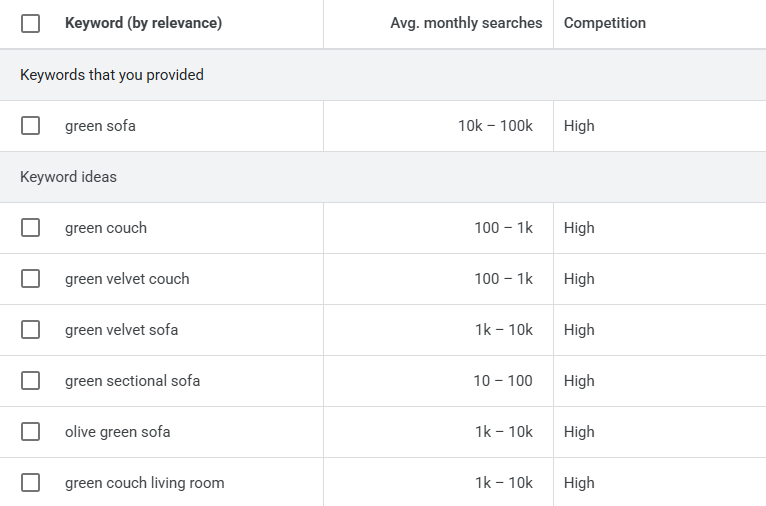
If you run an ad campaign using Google Ads, choose a relevant long tail keyword that’s going to help you get higher ad rankings without paying a premium. In doing so, you’re improving your return on investment.
Local SEO and Semantic Search
The new wave, the next evolution of the long-tail keyword, is the semantic search.
Take that long-tail keyword about growing turnips.
A semantic keyword is more of a real question: ‘What makes turnips grow faster?’
Search that on Google, and you’ll get a real answer.
This didn’t use to be possible. For a long time, Google – and other search engines – relied on individual keywords to figure out what content was about and to piece it together. Now, though, Google is finding ways to parse semantic questions.
Yes, this means that your grandma’s way of asking Google a full question will no longer be something to mock; it will be the way things work.
Part of the reason why semantic search is becoming increasingly important is because of AI.
You don’t spout keywords at the voice assistant asking you what you want; you ask it a question. The companies behind these programs have put an exceptional amount of time into learning how to parse questions, getting meaning out of them despite attempts to confuse them. They’ve done a very good job. The end result is a robust engine that takes a sentence and parses out meaning. The other end result is using that meaning – in the form of long-tail keywords – to find valuable content.
How Search Engines Understand Context
You may still hear people talk about “LSI keywords” when describing words and phrases related to a main keyword. However, this is outdated SEO terminology and not a useful way to explain how modern search engines understand content.
Google’s language-matching systems can recognise relationships between words, concepts and questions. This means a page can appear for a relevant search even when it does not contain the exact phrase someone typed.
For example, a useful guide about growing turnips might naturally discuss soil conditions, planting times, watering, pests and harvesting. These are not “LSI keywords” that need to be added to satisfy an algorithm. They are relevant subtopics that help create a complete and genuinely useful guide.
This approach is often described as topical relevance: covering the connected questions and subtopics people need to understand rather than repeatedly targeting one keyword.
Rather than compiling a list of related terms and forcing them into your copy, focus on the searcher’s intent. Answer the main question clearly, cover the supporting questions someone is likely to have and use the language your audience would naturally use.
When content covers its subject properly, the relevant terminology and context will usually appear naturally.
Creating Quality Content
I’ve been saying this for a couple of years now, but it’s becoming more true than ever before: the key to ranking good content is just to make good content. You don’t need to care about specific keyword phrases or keyword density. To Google, ‘how to grow perfect turnips,’ ‘how to plant turnip seeds,’ and ‘turnip growing guide’ all have more or less the same meaning. Instead, just write good content about your topic. If you’re writing about how to grow turnips in your garden, chances are you’re going to cover all the keyword bases just writing the piece.
The only reasons you wouldn’t are because you’re intentionally avoiding a certain keyword, or you’re not writing about the topic you thought you were.
So, successful use of long-tail keywords in 2026 mostly revolves around writing good content, conversationally. If you want to cover a specific keyword, write something about that topic.
Don’t try to write something general and shoehorn the keyword in; that’s just going to look like keyword stuffing.
That does not mean a page can rank simply because it mentions the right phrase. If you target “how to grow flavoursome turnips” but provide little useful information about growing turnips, the page is unlikely to satisfy the searcher’s intent. The phrase itself cannot compensate for shallow or irrelevant content.
Keywords as a whole are never going to die. It’s literally impossible for that to happen; search engines are searching and indexing text, and text is made up of words. Any article is by necessity going to have keywords. You can even write nonsense, like Lorem Ipsum, but even that phrase ‘lorem ipsum’ is a keyword. Anyone searching for lorem ipsum related content wants that keyword to be part of the content.
Until such time as humanity moves to a form of communication beyond verbalization or the written word, keywords will exist and will be used to index the meaning of content.
The only thing that’s going to change over the next few years is the increasing sophistication of the ways Google and other search engines parse content and extract meaning.
While long-tail and semantic keywords are still fundamental to how content is discovered, it’s more accurate to think in terms of topics, intent and contextual relevance rather than specific keyword formulas.
Modern search engines don’t rely on keyword density or outdated concepts like “LSI keywords”; instead, they evaluate how well a piece of content genuinely covers a subject, answers real questions and aligns with user intent.
Keyword research still matters, but its role is to guide what to write about.
Not how often to repeat a phrase.
The more clearly and comprehensively you address a topic, the more naturally your content will align with the queries people (and AI assistants) actually use.
How to Find Long Tail Keywords
SEO tools are invaluable for getting suggestions, but you can also find them in other ways.
For example, enter your search term into the Google search bar and see what suggestions come up. Not all of these will be long tail keywords, but it’s a good place to start.

You can also scroll to the bottom of SERPs and look at similar search queries that other users have made. These often make for excellent suggestions.

Where to Use Your Long Tail Keywords
Spoiler alert: Pretty much the same places where you use your short tail keywords.
So let’s start.
URLs (plus Breadcrumbs)
URLs do not have a massive impact on rankings but nonetheless, having a readable URL that includes relevant keywords can contribute to an improved user experience and your overall search visibility. You can optimise your URL by making it reflect the content of your page, i.e. mention your keywords.
A proper URL structure will provide the basis for seamless breadcrumb configuration.

Header Tags
Header tags are mainly used to highlight both the titles and subtitles in your site copy. By placing your main keywords in the header tag you are telling Google that the keyword is relevant to your copy. You should use your main keyword in header 1 tags and secondary keywords in header 2 and header 3 tags.
Website Metadata
Title Tags
Title tags are another example of meta tags that we talked about above. You can indicate to search engines what the title of your page is with a Title Tag.
Title Tags are hugely important for SEO: they are the first thing that search engines and users will come across that will identify the content of your page. Google may use your title tag to generate the clickable title in search results.

Make sure to create an informative title that includes your most important keywords, and make sure to mark this with a Title Tag in your page’s HTML source.
Meta Description
The meta description is the short paragraph in the SERP that gives a quick insight into the page’s content. While not crucial for Google rankings, optimising your meta description is very important in helping Google understand your content and gaining user click-through from SERPs.

If you don’t determine your description yourself, Google will try to assess your content and take a few lines of your content that best answers the user’s query. As the person who knows (and can sell) your content best, it’s important to provide this info yourself. Make it easy for search engines to understand your page!
These short paragraphs are your opportunity to advertise content to future prospects. Use your keywords and let them know exactly what your page has to offer with regard to what they are searching for. Tools such as Yoast SEO Plugin makes it easy for anyone with a WordPress website to edit their Meta Description.
Content
Providing Google with high quality and unique content is unquestionably vital to the success of your business.
This means writing content for the user but also for search engines. Genuinely useful content finds the balance between SEO and a seamless user experience. Have keywords in all the right places but don’t overuse them.
Just remember, go for a liberal keyword distribution throughout. You should not overstuff your content with keywords, as it is written primarily for human readers, and only after that, search engines.
Social Media
Having a strong Social Media presence can drive traffic to your website.
Assuming you have carried out keyword research, then you already have a lot of info on the content your target market is looking for. You can use this research to target your audience on social channels too and implement an effective social media marketing strategy.
By producing keyword targeted, relevant and high-quality content on your social accounts, you can position yourself as an influencer and market leader. This can have many benefits.
Traffic
Social Media doesn’t directly affect your ranking, but it can send lots of traffic to your website if you’re doing it right, and more traffic can improve your SERP ranking for particular keywords.
Profile Rankings
Social media profiles rank in search results too, you can use your keywords to optimise your social media snippets to gain more clicks and improve your brand visibility and awareness.
Social Media Search
Most social media platforms also have extensive search functions. Many people will look for local businesses and news on Facebook or Twitter even before checking Google. Therefore it is important to use your keywords to position yourself well in social media searches.
Links
Backlinks, also known as inbound links, are links from other sites to your site and are viewed by Google as votes of confidence in your content.
In other words, these inbound links are like another page saying:
“Check out this content, it’s really good!”
The more inbound links that you get, the more website owners and other internet users are finding your content relevant and helpful. This is indicated to Google by these people voting for your content via inbound links. Google and other search engines value this kind of social validation.
However, in a search engines’ world, not all backlinks are created equal.
Search engines are designed to value not just the number of backlinks you have links but the quality of those links. Over-optimisation (where you have a very high volume of low-quality links) can negatively affect your search engine ranking.
The main reason for this is to prevent search engines from being manipulated by low-quality sites or linking to each other to get top rankings. So, the very first step in building links is to find websites from which you can get high-quality links.
High-quality links are from popular, authoritative websites that produce well-respected content around your keywords.
To find these websites you need to research what content your target audience reads and then begin building a network of links from these pages.
Anchor Text
Google uses the visible, clickable text in a hyperlink (the anchor text) to help determine the subject matter of the linked-to page.
For example, a partial-match anchor text saying “guide to long tail and semantic keywords” is much better than simply “Source,” or “Click Here” because this doesn’t tell Google anything about the webpage that it is linking to.
Match Search Intent
This step is hugely important and often overlooked. It basically means using your keywords wisely! If you want to earn high rankings in the SERPs you need to provide content in the format your audience wants to see it in.
You can perform in-depth and accurate keyword research but if you don’t use your keywords in combination with the right type of content, then you won’t improve your rankings.
Now we come back to AI, which we mentioned at the beginning. We still want to understand search terms and (where possible) identify repeating long-tail keywords.
Get into the shoes of your customers and think about what they are looking for (frequently).
These searches show real demand, which can help businesses plan content, understand customer needs, and make more informed sales predictions.
However, when we talk about matching search intent, this has become even more important. It is not just about placing long-tail keywords on a page. It is about understanding what the person really wants, answering the query properly, and satisfying their curiosity. After all, this is what AI systems are trying to do as well, and if your content does that well, there is a better chance AI may direct that query your way.
Practical Workflow
- Find relevant queries: Use Google Search Console, Keyword Planner and customer questions to identify searches related to your products or services. For example, a furniture retailer might explore “small oak dining table”.
- Check search intent: Review the pages appearing in search results to understand what people want. Product pages, category pages and sizing guides can reveal whether someone wants to shop, compare options or find advice.
- Group related queries: Bring together searches with the same intent that one page can answer. For example, “small oak dining table” and “compact oak dining table” may belong on the same category page.
- Choose the right page: Improve an existing page that matches the searcher’s needs. Create a new page when the topic serves a distinct purpose that your existing content does not cover.
- Write useful content: Answer the main question and relevant supporting questions clearly. For an oak dining table category, include information about dimensions, seating capacity, finishes and delivery.
- Measure results: Track impressions and clicks in Search Console alongside enquiries and sales through your website analytics. Compare performance over time and use new search queries and customer questions to guide further improvements.

To Summarise
Optimising your website for long tail keywords is a solid way to improve your ranking in search engine results, while also honing in on users who are specifically looking for the kind of information, products, or services you provide.
Users who know what they want are more likely to be serious about making a decision, which means a boost in your conversion rate.
