

Let’s say you own a local landscaping business. You’ve got yourself a shiny new website to help attract more clients and let everyone know you’re here.
Read also: Local Landing Pages
It’s got a sleek design, a smart structure, and you’re even keeping the blog updated with helpful gardening guides full of relevant keywords.
And yet, you’re not getting the influx of email inquiries you’d hoped for.
You’ve put in the groundwork (pardon my pun), but you’re not seeing the fruits of your labour (sorry, couldn’t help myself).
To get found by local customers you need to rank highly in local Google search results, and this is something you can’t leaf to chance.
Sorry, that’s the last thyme.
I mean time.
If keywords are the roots that anchor your website to Google’s index, then local citations are the fertiliser that’s going to give you a boost on the search engine results pages.
‘What are local citations?’
I hear you cry.
Well, since you asked…
Local citations are examples of when your business is mentioned on other websites. To count as a local citation, the mention doesn’t have to link to your website, although that always helps.
The citation does need to include your business name, address, and contact information. There are a range of ways you can get your business mentioned online, which we’ll get into later.
But for now, let’s look at why it’s important to build local citations.
What Is Local SEO?
Local SEO is an important cornerstone in building revenue and reputation for every business, small or large. People like to deal with businesses in their area and this desire is reflected in the way they search online. As a result, having a strong online presence is a great way of increasing your brand awareness, targeting local customers and driving new revenue. Staying competitive is the key.
Let’s look at the statistics:
- Local search behaviour has become more immediate and action-focused. Google reports that searches for “open now near me” grew globally by over 400% year over year, while Google Maps searches for “shopping near me” grew globally by over 100% year over year (source: Think with Google). This is why accurate opening hours, addresses, phone numbers and business categories matter.
- Local citations matter because people regularly search online for nearby businesses. Recent research found that 80% of U.S. consumers search for local businesses online at least once a week, while 32% do so daily. BrightLocal
- According to SOCi research, 72% of consumers used Google Search in the last 30 days to look up information about a local business. This shows why accurate local citations matter: customers are regularly checking business details such as address, phone number, opening hours, directions and website links before making contact or visiting. SOCi
- An older local SEO statistic often cited by HubSpot says that 72% of consumers who did a local search visited a store within five miles, but for a current article, newer consumer behaviour data is stronger. HubSpot
Back in the day, if someone wanted to find the number of their local electrician, they would probably drag out the physical 10kg yellow pages directory and flick through the millions of pages until they found the right phone number.
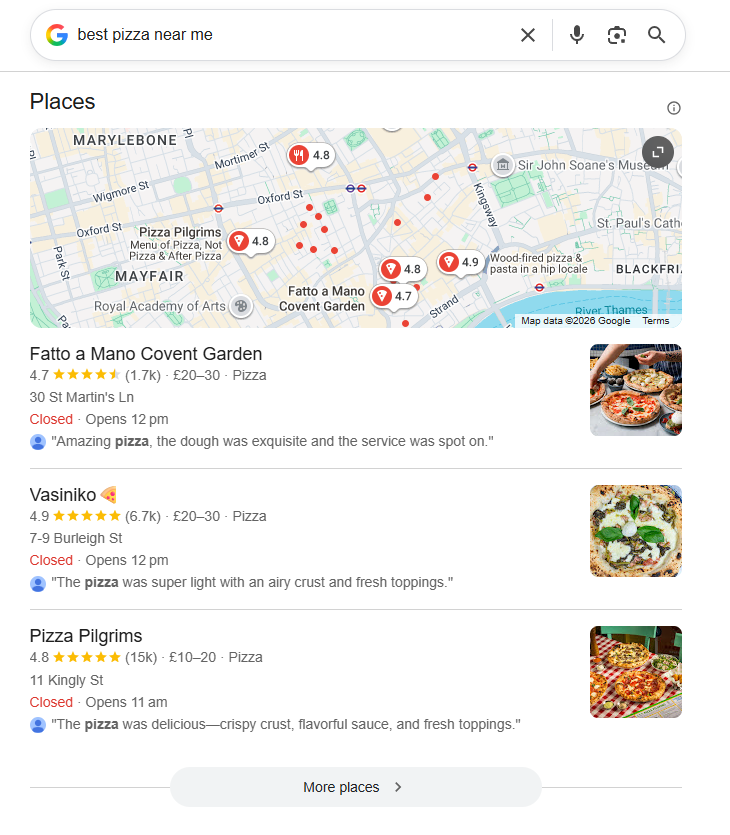
Today? They’re more likely to use a ‘Local Search’. In this case, that would mean they type “best pizza near me” into Google and then choose a number to call out of those results.
How do you take advantage of that?
Optimising the factors below is all part of a Local SEO strategy and can help to drive local traffic and attracting a target audience to your business and help you become a go-to service provider in your area.
Local SEO optimization includes:
- Keyword Research
- Reviews Management
- Link Building
- On-Page SEO
- Local Citation Building
As well as focusing on these core factors, Local SEO also uses standard SEO practices and localizes them where necessary. For example, if you want to create a specific landing page for each of your business locations, you should still optimize these pages for optimal search engine ranking as normal:
- High Page Speeds
- Keyword Implementation (Keyword + city)
- Link Building
- Technical SEO
- Usability
So now that we understand the importance of Local SEO, let’s take a look specifically at how to get the citation building part done right.
How Do Local Citations Work?
Local citation building is one area of local SEO that shouldn’t be ignored if you want to appear on search engine results pages for local searches. That’s because Google wants to bring relevant and trusted information to its users, and one way that it can determine if you’re a trusted source is to corroborate your information with other websites.
If you’re a local business with your own website, but there’s no mention of you in any online directories or local news outlets, you don’t appear very reputable. However, if Google can crossmatch information from your website with other websites, for example, your business address and phone number, then it gives your website and business more credibility.
And credibility is exactly what Google is looking for when it brings results to its users.
Essentially, the more times your business is mentioned online, the more prominent and authoritative you look to search engines, and therefore you’ll appear more prominently on their SERPs. More prominence on Google translates into more traffic to your website, which means more opportunities to convert visitors into customers.
What Kind of Information Is in a Citation?
When someone performs a local search they are more likely to engage with a business that has a combination of the following factors easily visible and available online:
- Google Business Profile
- Reviews
- Contact Information
- Location and Direction
- Opening Hours
- Images
- Social Media Channels
These are all details that a business citation can contain. The more reliable information that a user can quickly and easily find about your business increases the likelihood of generating business from them.
Therefore you need to make sure that your business’ information is easy to find online, and more importantly that the information is accurate. To achieve this you need to keep your citations up to date.
Types of Local Citations
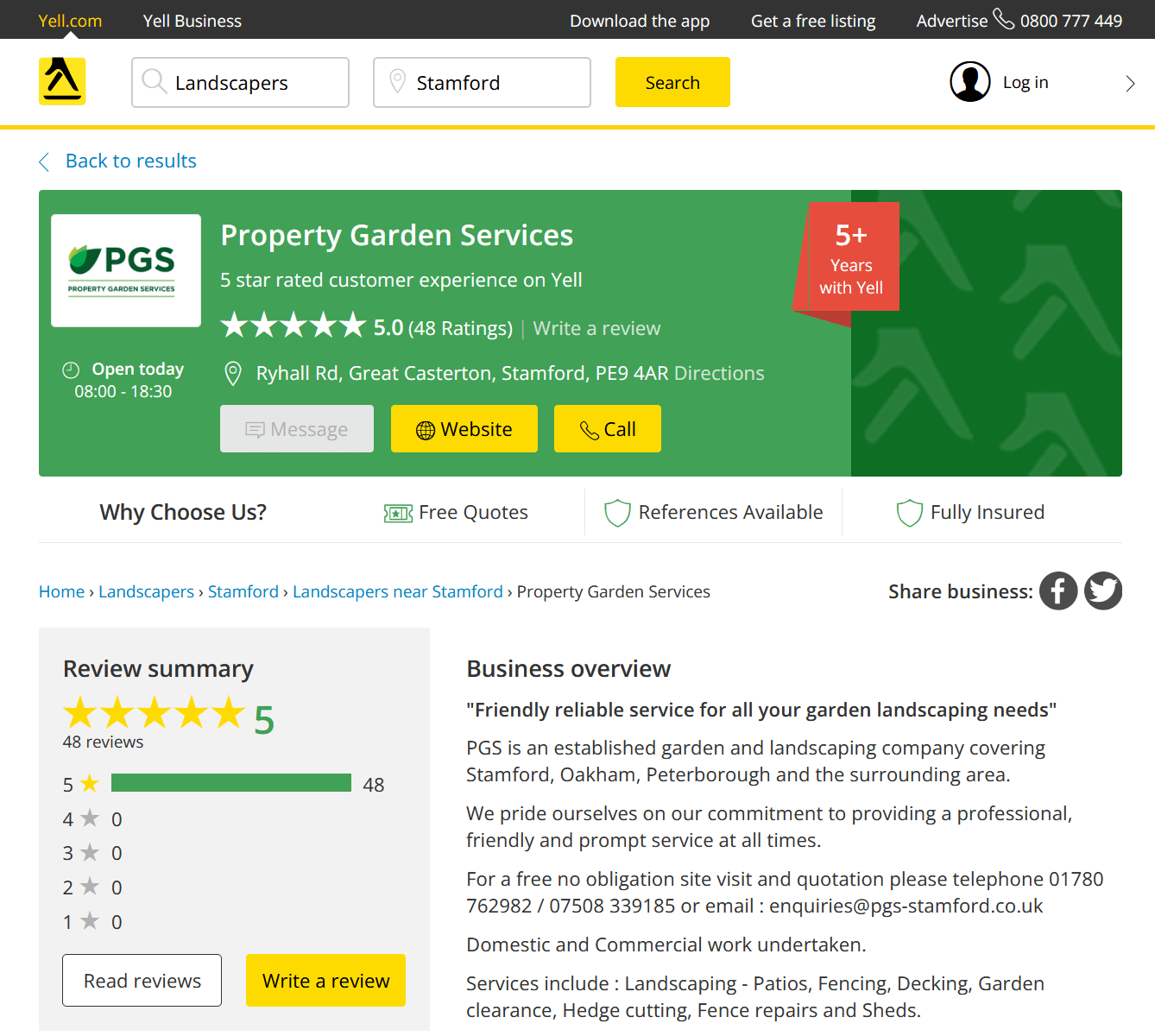
There are two types of local citations, and both are valuable to your local SEO efforts. A structured local citation is usually found in an online directory or review site, such as Yell, Tripadvisor, or TrustPilot. Structured citations will look something like this:
Unstructured citations are the second type of local citation, and these are instances where your business is mentioned in a more natural context online. This could happen when someone on social media recommends your services, or you might appear in a local news story.
To count as a citation, your business name and contact details need to be supplied.
What Is a Local Citation?
Local Citations then are citations in websites specific to the location you are targeting. For example, you could list your business with the local Chamber of Commerce or local unions and business associations. These are useful as they will show up for local users and help build trust with your target community.
Citations might be uploaded by your organization (e.g if you claim and update your own Google Business Profile) or can appear without your knowledge (e.g. a blog copies your details from a directory). Either way, it is your job to make sure that your citations provide consistent and accurate information.
Build Your Local Citation Profile
Now you know what local citations are and why they’re important to local SEO. But how can you build them for your website?
Create Structured Citations
The great thing about structured citations is that these can be created by you, making them a quick and easy way to build your local citation profile.
Start with a Google Business Profile, then add the details of your business to as many relevant directories you can find. Online directories such as Yell will allow you to set up a business listing for free.
You should also set up a number of social media profiles and create a structured citation with your business name, address, contact details, and website. If you come across examples of structured citations online that are incorrect, for example, there’s a mistake in your postcode, be sure to remedy this since errors can damage your online trustworthiness.
You want to ensure consistency across all of your local citations as this helps search engines to recognise that you’re a reputable business. This includes consistent business opening hours and typos in contact details.
Create Unstructured Citations
Unstructured citations are typically those you have less control over, but not always.
You can get yourself mentioned for free in the local press by doing things that are newsworthy and letting local news outlets know about it.
For example if you’re launching a new service, or adding a new premises to your business, a local online news site may be interested in this. Holding charity or community events can also help you get mentions on local websites, for example consider sponsoring a local school’s summer fair or raising money for a local hospital.
Run a Google search for your business and trawl through all of the results to see where you are already mentioned online. Get in touch with these websites and ask that they list your address and phone number alongside your company name, to transform a mention into an unstructured citation.
Local Citation Building
Citation Building is the process of cleaning up existing citations, deleting duplicate citations, creating new citations and managing all citations going forward.
There are three types of online places that contain business citations:
- Local Business Data Platforms
- Geographical Directories
- Other Websites
Your business should have citations on all three types. Assess which sites will be most relevant to your users and your business and make sure that you have a citation there.
The most important citations to make sure that you have are (depending on the type of business):
- Google Business Profile
- Yelp!
- Yellow Pages
- Manta
- Mapquest
- Local Search Results
- Checkatrade
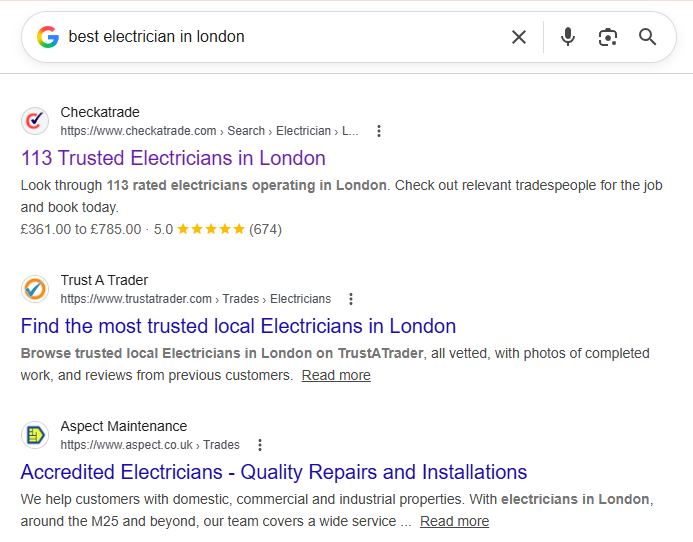
For service-based businesses, citation platforms and trade directories can appear very prominently in local search results, as shown below.
How to Build Local Citations
Step 1 – Claim/update/build citations on the most important sites listed above. Go straight to the important sites. Having your citations on the most important sites can boost your local traffic from the get-go. Do this first and then work on building other citations later.
Step 2 – Search for your existing citations. Your business may already be listed on several platforms and cited in various publications. Search your business and analyse the results. It is important to find any inaccurate data, so try searching for your business name + old phone numbers/old addresses too.
Step 3 – Claim other existing business page listings. Claim citations that already exist. Verify that you are the owner of that listing. This is often done with a phone call, email or postcard, and a pin code that you will confirm.
Step 4 – Clean up incorrect citations. Once you have claimed your business listing, update the info to create a consistent business profile. Contact the host of the citation and request a change.
Step 5 – Research competitor listings. Competitor analysis is key to business growth. Find out where your competitors have their citations listed and assess whether you should implement the same steps.
Step 6 – Build new citations. The average number of citations for local businesses in the top 10 SERP positions is 81. Your citations should be accurate, high quality and include the most popular citation sites and localized sites.
Tools for Building Local Citations
Managing citations can be a huge task. It can be undertaken manually on a small scale but often the constant management that is involved leads businesses to automate or semi-automate the process.
Here we have gathered a list of tools to help you do build high quality citations on a larger scale:
- Moz Local
- Whitespark
- Uberall
- Yext
- BrightLocal
- Synup
- SEMrush
Check out our blog post Google SEO Tools to find some other useful SEO tools to take your online presence to the next level.
Why Is Citation Building Important for Local SEO?
So now we know how to build citations. But why are they so important? Because when people search with local intent, they search with high intent. People who want to buy a product or service usually want to do so locally. Yes, eCommerce is booming, but people still want to do business in their communities.
Local searches have high conversion rates. When people search “service + near me” or “keyword + city” it probably means they want to make a purchase and want to find the best, local option to do so. High intent means people want to do business in the immediate future. And what do they need to do that? Yes, you guessed it, your NAP. (Name, Address, Phone number, in case you forgot!)
As part of Local SEO we should want to make it as easy as possible for the users to make a purchase with our business. This means:
- Give them your NAP
- Show them reviews
- Tell them your opening hours
- Give them directions to your building
- Share your social channels
Citation Building is an inherent part of capturing local traffic. It makes sure your business information is up-to-date and easily available for high intent, local searchers.
The Risks of Not Managing Your Citations
There are two main reasons for businesses to develop and manage an accurate and reliable bank of citations: customers and ranking in Local SERPs.
Customers
If a potential customer finds conflicting opening hours and contact information for your business online… they won’t know which information is correct and will move on to a competitor who has provided more consistent details.
We cannot stress enough the power that managing your local citations can have in helping your business grow organically. People will respond to businesses that maintain their online presence. Accurate citations and listings will help win you local customers and boost your brand reputation.
Ranking in Local SERPs
Google won’t rank you high in search results if your business is represented by conflicting information on the web. As mentioned before, citations for a business can often appear without the knowledge of the business owner. This happens with the natural flow of information on the world wide web.
There are many ways that business citations can occur without your knowledge. As this information is not coming directly from your business, it can often be incorrect or outdated. Have you changed your opening hours or address or phone number recently? 3rd parties won’t keep track of that and can’t be relied upon to update your citation.
Inaccuracies give Google a bad impression of your business. And that’s not good for rankings. Google will promote businesses that provide a consistent and holistic profile across every platform. They don’t want to show searchers confusing information. The volume of accurate citations that you have can help your SERP rankings. To make sure that your business ranks high in local searches you need to optimize and manage your citations across every medium.
Local Citation Management
Once you’ve gotten to grips with local citation building and ensured your business is mentioned on a range of other websites, remember the work doesn’t end there. It’s an ongoing process.
Since you’re not the only one who can mention your business online, you need to keep track of any local citations that appear and ensure they’re correct. You may also need to update local citations if you move business address, change your phone number, or alter your opening hours.
A good way to keep on top of local citations is to set up a Google Alert for your business name so that you get notified any time your business is mentioned online.
Final Thoughts
Local citation building is a major part of local SEO. If you’re running a business that relies on local custom, such as a florist, a hair salon, a restaurant, or a window cleaning service, then you need to get on board with this.
This is going to make you easier to find online when anyone local to you conducts a search for the type of product or service you offer, and ultimately bring you more leads and potential customers.
How will anyone find you if they don’t know you exist?
Want some guidance for your site? Contact us today.
