
Depending on your SEO experience and knowledge, it can take a lot of time and effort to get your website ranking on the first page of search engine results pages.
Wouldn’t it be useful to put your website in front of the right people quickly while your longer-term SEO work continues?
Enter PPC.
PPC, or pay-per-click, is an advertising model that can help your ads appear prominently in search results relatively quickly.
So why do we say relatively? Isn’t it simply a case of setting up a Performance Max campaign in a few clicks, using Google’s built-in AI and – voilà – appearing in front of your customers?
Not quite. Consider an extreme example: an online casino creates ads claiming that it sells gaming keyboards. Someone clicks, and instead of finding keyboards, they land on a gambling website. Google reviews an ad’s headline, description, keywords, destination, images and video for policy compliance. The ad and the page it leads to must accurately represent what the user will find. You can read more about this in Google’s ad review guidance.
The mismatch does not need to be that dramatic. If an ad says “five-star rated based on 300 reviews” when the business has only one review, or calls the business “award-winning” without a genuine award, those are misleading claims. The landing page should also explain the service clearly and identify the business behind it. A missing Team section alone is not an automatic rejection, but thin or unclear information can weaken trust and the landing-page experience. Google addresses inaccurate and misleading claims in its misrepresentation policy.
So, when we say relatively, remember that Google does not automatically hand over the space above the organic results just because an advertiser is willing to pay. Most ads are reviewed within one working day, although more complex reviews can take longer. An ad that breaches policy can be disapproved.
That review protects the search experience. If paid results routinely misled people, users would not suddenly decide that page two held the best answers. They would be far more likely to lose trust and move to another search engine.
PPC shouldn’t be considered an alternative to SEO methods, but it can work well alongside SEO to complement it. Intrigued? Good, let’s jump right in.
What Is PPC?
PPC, which stands for “pay-per-click”, is a type of advertising strategy in which the advertiser only pays when a user clicks on their ad. It is a common way of attracting traffic to a website, alongside SEO practices that drive traffic more organically.
It commonly goes hand in hand with search engine advertising, but there are other platforms where advertisers can launch pay-per-click campaigns, including Facebook, YouTube and LinkedIn.
How Does PPC Work?
Search for a phrase such as “top hotels in Milan” and Google may show sponsored hotel results above the organic listings. These results can include prices, ratings and booking providers, as shown in the example below.
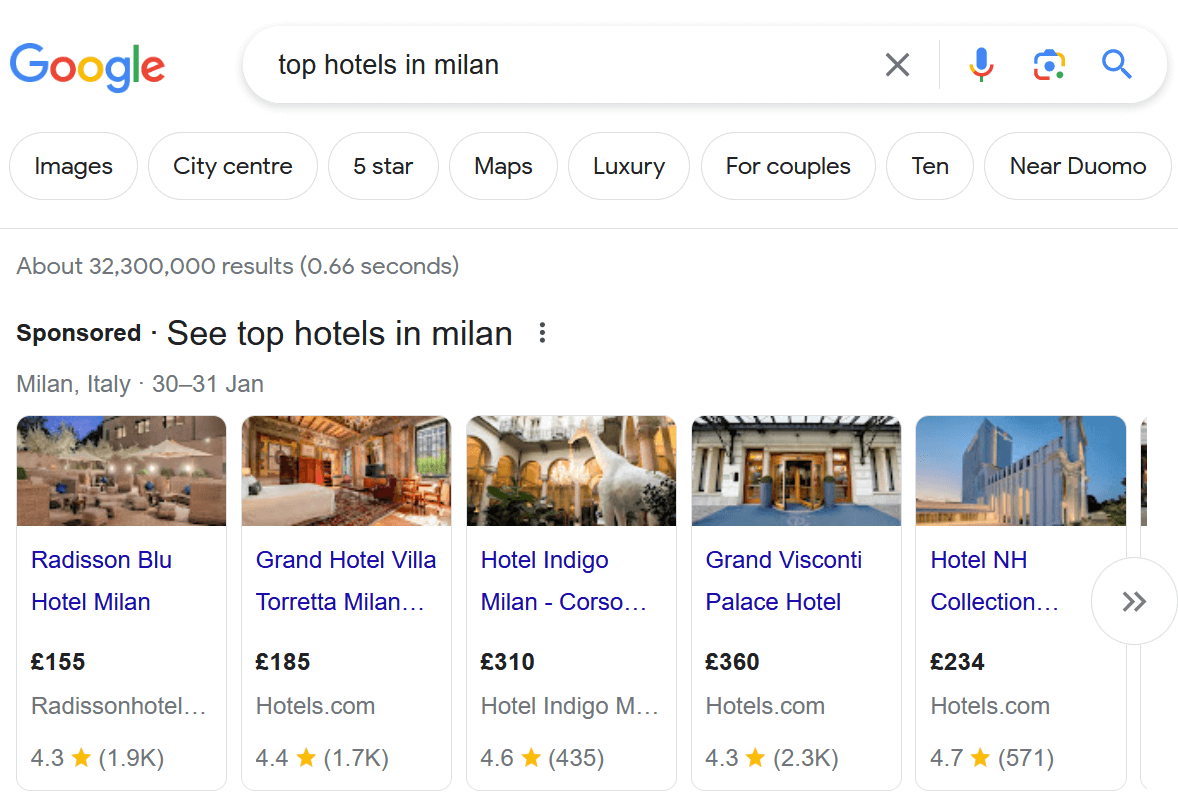
Simply seeing those sponsored results does not create a cost-per-click charge. Under a cost-per-click bidding model, an advertiser is charged when someone makes a valid click. Other campaign types can use different bidding and charging models.
Advertisers can target keywords, but Google does not simply show the highest bidder. Each eligible search triggers an auction. Ad Rank considers the bid, ad and landing-page quality, auction competitiveness, the context of the search and the expected impact of ad assets. An advertiser may target the exact phrase “top hotels in Milan” or a related keyword and match type.
PPC vs. SEO
PPC and SEO have the same aim. They work to get your website in the top spots on search engine results pages. But their methods are different.
With SEO, you’re running a marathon and the only way you’re going to complete it is with consistent training and putting one foot in front of the other.
With PPC, you hop on a bus and take the short cut. Either way, you’re going to get to the finish line.
With SEO, you’re working to get your website ranking amongst the top results on search engines for specific user enquiries.
Once you’re consistently ranking highly, you’ll have a consistent flow of organic traffic. With PPC, you create a campaign that can place an ad on a search engine or social platform for selected searches or audiences.
Under a cost-per-click model, you are charged for valid clicks. PPC is paid advertising; it does not improve your organic ranking.
Both of these methods can see an increase in traffic and conversions, but arguably they work best when used in conjunction with each other.
Benefits of PPC
Reach Your Target Audience
When creating a PPC campaign, you can identify a target audience, which enables you to get in front of the types of users who are more likely to have an interest in your products or services.
Control Your Spend
Compared with traditional advertising and some other marketing channels, PPC can be cost-effective when it is well targeted, measured and optimised. In a cost-per-click campaign, you usually pay for valid clicks, but a click does not guarantee an enquiry or sale. Conversion tracking is essential for judging whether the traffic is profitable.
Start Collecting Data Quickly
Once approved, a campaign can begin generating impressions and clicks quickly. This is faster than waiting for organic rankings, but profitable results are not guaranteed and usually require testing, enough data and ongoing optimisation.
Increase Brand Awareness
Recent benchmark data from more than 13,000 US-based search-ad campaigns reports an average click-through rate of 6.64% in 2026. Results vary substantially by industry, geography and campaign type (WordStream, 2026).
More recent Google and WARC research covering European brands found that a 1% increase in brand awareness was associated with a 0.4% increase in short-term sales and a 0.6% increase in long-term sales (Google/WARC, 2024).
This shows why advertising should not be judged only by immediate clicks. Impressions can contribute to brand visibility and longer-term performance, although not every impression will increase awareness or lead to a sale. Measure impressions and reach alongside clicks and conversions, and consider brand-lift measurement when awareness is a primary campaign goal.
Measure Your Success
You can measure the success of any PPC campaign using analytical tools, and this can be crucial for adjusting your marketing efforts going forwards.
Creating a PPC Strategy
Here are the key steps you should take to launch a successful PPC campaign.
- Planning and research
- Budget
- Keywords
- Campaign and bidding strategy
- Formulate your campaign
- Enticing ad copy
- Landing page
- Call to action
- Analysing performance and KPIs
- Adapt and improve
Planning and Research
Before launching your PPC campaign, you need to put in the prep work. We all know the old adage: fail to prepare, prepare to fail. Well, it’s no different with a PPC campaign.
If your strategy is based on data, analytics and research, then you are setting yourself up for success.
If you are new to website analytics, check out our article on Google Analytics for Beginners, which covers all the basics you will need to jump into the world of website data.
To start off on the right foot, you should:
- Establish your budget.
- Research which keywords your consumers are searching with.
- Research which keywords your competitors may be targeting.
- Estimate likely keyword costs using Keyword Planner and available account data.
- Build your bidding strategy around that information.
Let’s look at how you can do that.
Budget
In a Google Search campaign, you choose keywords relevant to your business. Your ad may be eligible when a user’s query matches those keywords according to the selected match type and other signals. Your bid tells Google how much you are willing to pay or what outcome you want an automated bidding strategy to optimise for.
A higher bid can improve competitiveness, but it does not guarantee visibility or a particular cost per click. Google calculates Ad Rank using the bid, ad and landing-page quality, auction competitiveness, search context and the expected impact of ad assets.
Keyword costs vary widely by location, industry, intent, competition, ad quality and match type. Treat planning ranges from Keyword Planner as estimates, not guaranteed CPCs. A high-cost keyword can exhaust a small budget quickly if targeting and conversion tracking are weak.
This is why it’s so important to constantly monitor your PPC campaign and have a clear budget and strategy laid out.
- How many clicks is your ad getting?
- Has the search volume for your keyword changed?
- How much have you spent so far?
- How much do you want to spend going forward?
You always want to know how much you plan to spend and make sure your campaign stays within that.
When you have decided your budget and researched the keywords you want to target, you can put together a strategy for the best way to spend your money.
For most Google Ads campaigns, you set an average daily budget. Google may spend less on some days and up to twice that amount on others, while the monthly spending limit is generally 30.4 times the average daily budget. The campaign continues until you pause it or its end date is reached. Campaign total budgets are available for certain campaign types with set dates. Learn more in Google Ads’ budgets overview.
Keywords
A truly successful PPC campaign will be driven by accurate keyword research. This is how you make sure that your target audience will see your ads.
With a PPC model, you want to make sure that the people clicking on your ads are potential customers, or else you’ll feel a dent in your ROI.
WordStream’s 2026 benchmark across more than 13,000 US-based search-ad campaigns reported an average conversion rate of 8.18%, but rates varied widely by industry and by what advertisers counted as a conversion. Treat benchmarks as context, not a forecast. For a simple hypothetical example, if 100 clicks at £1.50 each produce three conversions, the cost per conversion is £50. Use your own margins, lead quality and customer value to decide whether that is sustainable (WordStream, 2026).
Keyword research is crucial for creating your PPC campaign. It will affect the types of users you reach, the cost of your clicks and your conversion rates.
The Keyword Planner example below starts with “best hotels in Milan” and shows more specific variations, including “best hotels in Milan near Duomo”, alongside estimated monthly search ranges and competition.
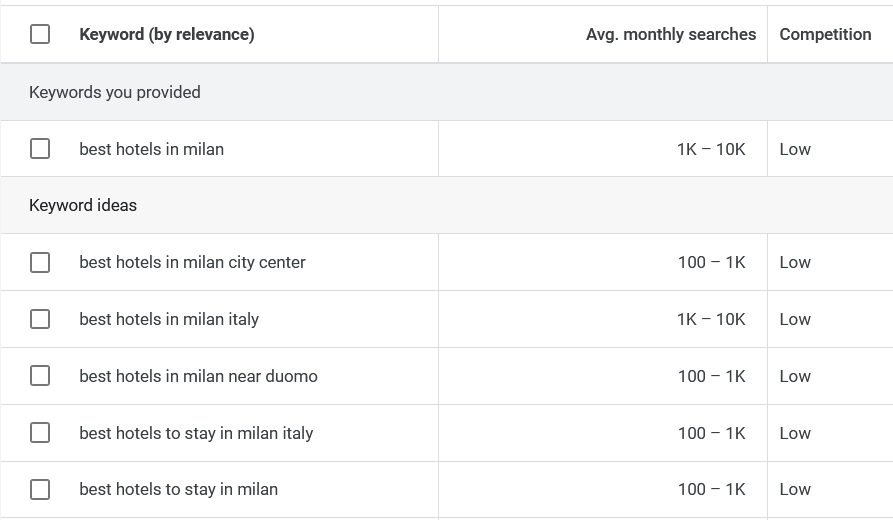
That narrower phrase may reflect clearer location intent, but a more specific search does not guarantee a purchase.
Broad searches are often used earlier in the buying journey. More specific keywords may reduce irrelevant traffic, face less competition and help qualify leads, but costs and performance still depend on the auction.
You can attract targeted visitors by doing thorough keyword research. Here are some of the tools you can use to find the keywords your business should target:
- Brainstorm possible keywords.
- Use keyword tools such as Google Keyword Planner, Semrush, Moz and Ahrefs.
- Analyse consumer behaviour with Google Trends and Google Search Console. The Performance report can show the queries that already bring visitors to your site. Google Autocomplete, People also ask and Related searches can reveal additional language and questions used by your audience.
Once you have done your keyword research, you want to use this information to create a great PPC campaign. There are a few different perspectives you should look at when choosing keywords for your campaign.
Search Volume
High search volume offers more traffic potential, but it often comes with more competition. Lower-volume terms can be more specific and commercially useful, although they may generate too little data or be classed as low search volume. Balance reach, relevance, cost and intent.
Competition
Successful online business owners never make the mistake of not analysing the competition. What keywords are your competition targeting, and is their strategy working for them? Have they overlooked a niche in the market that you can leverage?
Short-Tail and Long-Tail Keywords
Short-tail = one or two words, for example, “running shoes”.
Long-tail = a phrase or sentence, for example, “women’s black Nike running shoes for a marathon”.
Short-tail keywords often have higher search volume and stronger competition. Long-tail phrases usually have lower volume, but they can capture more specific intent and produce better-qualified clicks when they are relevant to the offer.
Negative Keywords
Negative keywords prevent your ad from being triggered by specified unwanted searches. They reduce irrelevant traffic and help protect your budget, but they cannot guarantee that every click will come from a potential customer.
You want your ads to be seen by people searching for your keywords. Unfortunately, so do your competitors. The quality of your campaign and your bidding strategy will determine the visibility of your ads.
Pick a Platform
Google Ads is one of the most widely used platforms for PPC. Meta Ads Manager lets you run campaigns across Facebook and Instagram.
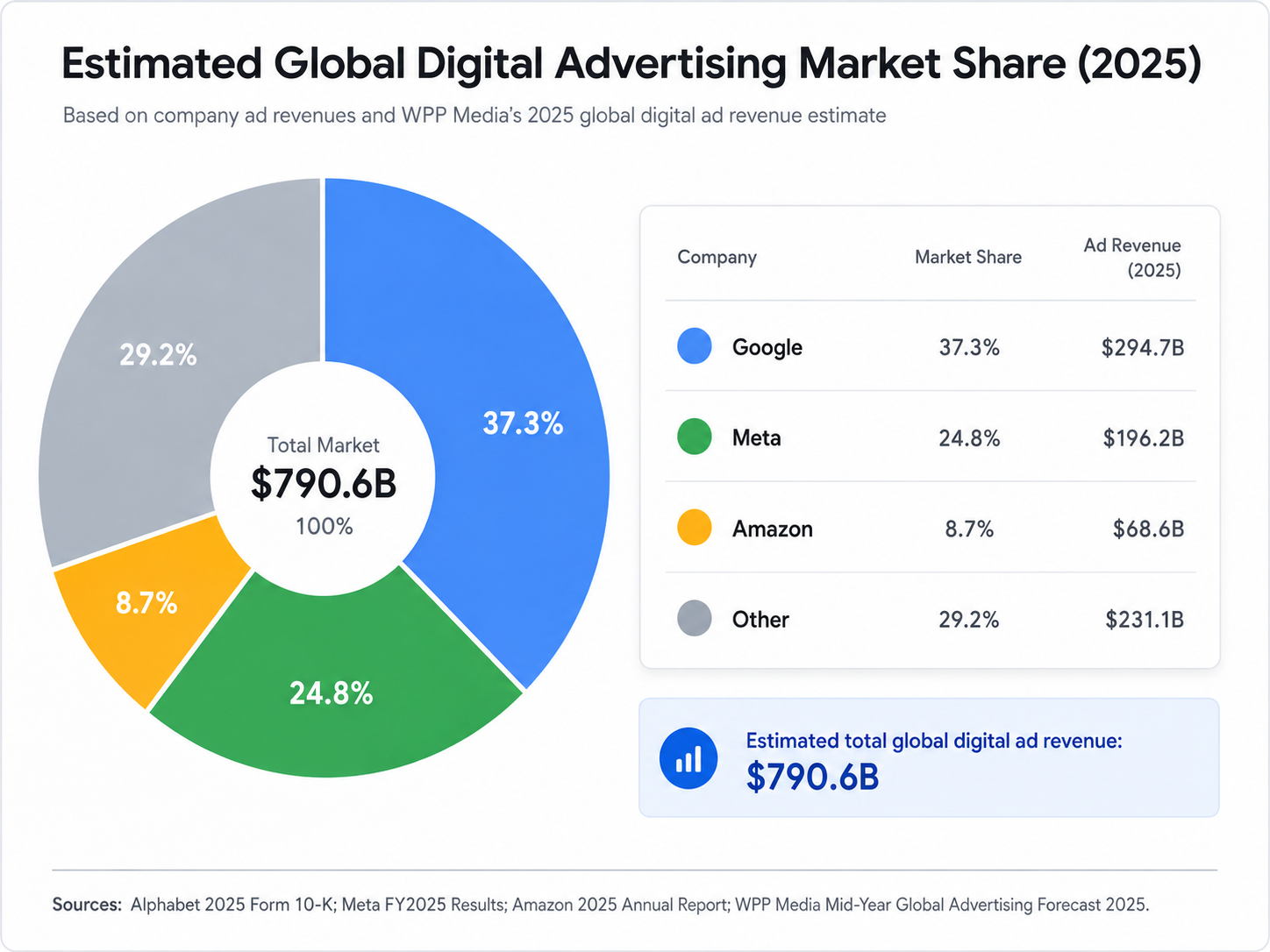
The illustration below shows an estimated 2025 global digital advertising revenue split, with Google at 37.3%, Meta at 24.8% and Amazon at 8.7%. It covers digital advertising as a whole, not PPC alone, so treat it as market context rather than proof that one platform is best for every campaign.
TikTok Ads and Microsoft Ads are other options, and LinkedIn Ads can be a good place to get in front of a professional audience.
Monitor Your Campaign
Use platform and analytics data to monitor clicks, search terms, conversions, cost per acquisition or return on ad spend, and landing-page behaviour. Review performance against a defined business goal and avoid judging success on traffic alone.
Beyond Keywords: Audience Targeting in PPC
Depending on the platform and campaign type, audience segments can be used alongside keywords, as observations, as targeting or as audience signals. They can be based on demographics, interests, habits, recent purchase intent or previous interactions with your business. Google provides more detail in its guidance on audience segments.
This is called audience targeting, and it’s worth understanding even as a beginner because it can make your budget go further.
One of the most useful audience types in Google Ads is called in-market audiences – people who are actively researching or comparing products like yours. Here’s a quick look at how they work and how to start using them.
What Are In-Market Audiences?
In-market segments are designed to reach people whose recent activity suggests that they are actively researching, planning or comparing products and services. They indicate recent purchase intent; they do not guarantee that someone will buy.
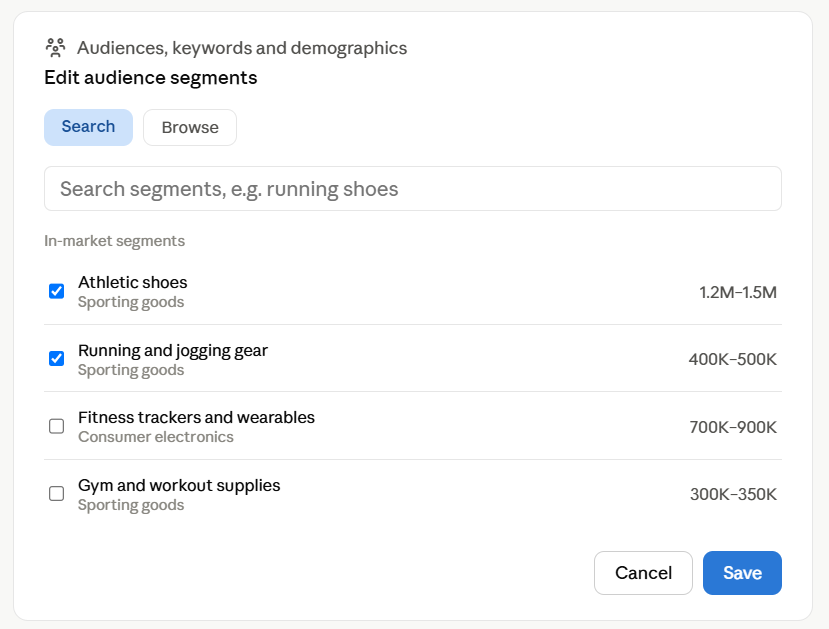
The Google Ads example below shows in-market segments such as “Athletic shoes” and “Running and jogging gear”, together with estimated audience sizes. It illustrates how advertisers can select a relevant category without seeing an individual user’s browsing history.
These segments can help you reach people exhibiting pre-purchase behaviours such as:
- Browsing products or services.
- Researching products or services.
- Comparing products or services.
How Do In-Market Audiences Work?
Google estimates audience-segment membership from aggregated activity signals across Google products and, depending on the context, third-party websites. Advertisers choose segment categories; they do not receive an individual user’s browsing history. Signals and segment availability vary by campaign type.
Which Users Can You Reach Using In-Market Audiences?
Affinity and in-market segments are different. Affinity segments focus on longer-term interests and habits and are commonly used for reach and awareness. In-market segments focus on recent purchase intent and active research, so they are usually closer to consideration. Branded searches and queries containing terms such as “buy” or “quote” may indicate stronger bottom-of-the-funnel intent, although context still matters.
In-market audience targeting can help you reach people who are:
- Making product comparisons.
- Checking out reviews.
- Carrying out other product consideration activities before purchase.
How to Use In-Market Audiences in Google Ads
In Google Ads, open Audiences within the relevant campaign or ad group, choose Edit audience segments and select the relevant segments. Availability and labels vary by campaign type. For Search campaigns, Observation is generally the safer starting point because it lets you measure performance without narrowing reach; use Targeting only when you deliberately want ads restricted to selected audiences. See Google Ads’ explanation of Targeting and Observation.
Things to Watch Out For
In-market audiences are not a guaranteed quick win.
Results vary by campaign type, market, segment size and creative. Test in-market segments against a suitable comparison, track conversion quality and cost per acquisition, and avoid narrowing reach before you have enough data to make a reliable decision.
How to Get More From In-Market Audience Targeting
There are a few effective things you can do to jump over these costly hurdles.
Make Use of Combined Targeting
Combined segments let you intersect audience attributes such as detailed demographics, affinity, in-market and your data segments. Availability varies by campaign type, and every additional AND condition narrows potential reach. Check the estimated audience size before launch. Learn more about combined segments.
Undoubtedly, it would be advantageous if you can develop a rich, detailed buyer persona before you use combined targeting.
Copywriting Is Key
Match the ad copy to the user’s search and audience intent, and make sure the landing page delivers the same promise. Use specific benefits, genuine offers and clear calls to action. Only use urgency or scarcity when it is accurate and can be substantiated.
Use Your Google Analytics Data
Use first-party analytics and conversion data to understand which audiences, search terms and landing pages produce valuable outcomes. If Google Analytics 4 and Google Ads are linked and ads personalisation is enabled, you can create or import eligible GA4 audiences based on on-site behaviour. Do not assume that an in-market label equals a guaranteed purchase. Google Ads explains the process in its Google Analytics audience builder.
Quick PPC Launch Checklist
- Define one primary campaign goal and configure reliable conversion tracking.
- Set an average daily or campaign total budget and decide the CPA or ROAS you can sustain.
- Choose intent-led keywords and appropriate match types.
- Build an initial negative-keyword list and review search terms regularly.
- Confirm location, language, schedule and device settings.
- Align each ad with a relevant landing page and one clear call to action.
- Choose Observation or Targeting deliberately when adding audiences.
- Review conversions, lead quality, CPA or ROAS – not clicks alone – and change one major variable at a time.
Final Thoughts
PPC can provide visibility while the campaign is funded; when spend stops, that paid visibility usually stops too. SEO can continue generating organic traffic over time, so the strongest approach often uses both according to the business goal.
A PPC campaign works best when running in conjunction with a website that has been properly optimised for search engines and customers. It’s essential to put in the research and background work before initiating a PPC campaign to ensure you get the most for your money.
Audience targeting, including in-market audiences, can make PPC campaigns more focused by helping you reach people who are already showing signs of interest or purchase intent. However, it should still be tested carefully alongside keyword research, strong ad copy, useful landing pages and ongoing campaign monitoring.
