

AI is changing SEO, but it has not made the fundamentals irrelevant or removed the need for human judgement. Its greatest value is practical: it helps us research, organise, analyse and implement work faster. Most importantly, it saves the one resource we cannot replace: time.
For searchers, the change is obvious. Instead of opening several results and assembling an answer themselves, they can receive a summary, ask follow-up questions and compare options before choosing whether to visit one of the cited or linked pages. For website owners, that changes how people discover and evaluate a business.
AI works best as an additional layer within a sound SEO process. Give it reliable data, a defined task and relevant business context, and it can be extremely useful. Give it vague instructions or inaccurate information, and it can return a convincing answer that is wrong for the website.
There are two sides to the subject: using AI to carry out SEO work and optimising a website for visibility in AI-powered search. Before doing either, think like your customer. Your website must answer their questions, establish trust and make their next step easy.
What Does AI in SEO Actually Mean?
Using AI to Carry Out SEO Work
AI can support keyword organisation, content planning, internal-link analysis, technical audits, reporting and implementation. The key word is support. It can process a large amount of information quickly, but it does not automatically understand your priorities, customers, platform or appetite for risk.
I therefore see AI as a way to reach an informed decision sooner—not as a replacement for SEO expertise.
Optimising for Visibility in AI-Powered Search
The second meaning is improving the likelihood that your website will appear or be cited within AI-generated search results. This is sometimes called generative engine optimisation (GEO) or answer engine optimisation (AEO). In practice, much of it is recognisable SEO: useful content, crawlable pages, clear headings, internal links, good page experience and accurate business information.

Google’s current guidance for AI features and websites says established SEO practices still apply and there are no special technical requirements for AI Overviews or AI Mode. AI adds a new search experience; it does not remove the foundation underneath it.
How AI Helps With SEO Today
Keyword Research and Search Intent
AI is very good at organising a large keyword set, but I would not abandon traditional keyword tools.
For example, I may begin with Google Keyword Planner, enter seed terms, set the location and language, and export the results. That can produce more than 2,000 suggestions, while Keyword Planner’s automatic groups may not reflect the business or website.
This is where AI becomes useful. I can provide:
- The exported keyword data
- Priority services or products
- The audience, location and purpose of the page
- Irrelevant or misleading terms to exclude
AI can group related phrases, identify themes and turn the export into a practical spreadsheet. It can also help separate informational searches from commercial or local intent.
I still review the result. A high-volume keyword may be irrelevant; two similar phrases may need one page, not two; and a low-volume term may be commercially valuable. AI organises the evidence. It should not invent it or make the final business decision.
Content Planning and Editing
Content is AI’s natural territory. It can generate ideas, create an outline, summarise research and draft quickly. Speed and breadth are genuine strengths; accuracy and originality are not automatic.
Before using a draft, check whether it reflects:
- Your tone of voice
- Your brand values
- Your real products, services and first-hand experience
- The question and intent behind the target search
Why did you create the company? What have you learnt by doing the work? What can you tell a customer that a generic competitor cannot? Without those details, the result may be polished but interchangeable with hundreds of other articles.
I often think of AI as a content editor. Give it your expertise, examples and rough thoughts, then use it to improve structure and clarity. You remain the source of the value. My content writing tips for beginners explore this balance.
Internal Linking and Technical Audit Analysis
Technical SEO tools collect valuable information, but an export is not a strategy. AI can help bridge that gap.
Take internal linking as an example. A practical workflow could be:
- Crawl the website with Screaming Frog.
- Export the internal-link data using Bulk Export > Links > All Inlinks.
- Analyse the spreadsheet alongside the website’s priority pages and content topics.
- Identify pages receiving too few relevant internal links, overused anchor text or suitable contextual-link opportunities.
- Review and implement the worthwhile recommendations.
- Recrawl and re-export the data to confirm the changes.

AI makes the analysis faster, especially on a larger site. But it does not know which products have the best margins, which service is strategically important or whether a link would feel forced. Supply that context and check every recommendation.
The same method can support reviews of metadata, headings, images and schema. This technical SEO checklist explains what the audit data is describing.
Reporting and Data Interpretation
SEO reporting becomes complicated when platforms describe the same journey differently. Google Analytics, an email platform and Google Ads may attribute one sale to different sources because their models, windows or identifiers differ.
AI can compare exports, explain discrepancies and standardise labels. It can also group long-tail queries around a main topic, so a page is not judged by one headline keyword alone.
It cannot reveal a single “true” source simply by merging conflicting reports. The analysis is only as reliable as the tracking setup. Use AI to investigate patterns, then document the assumptions in your report.
Website Implementation and Automation
AI can help create a simple website and code common tasks. For a small brochure site, this may reduce the time and cost of getting an initial version online.
It is generally more reliable when the work is divided into focused tasks, such as:
- Suggest a page title and description for a defined search intent
- Create valid schema markup from verified business details
- Draft one service-page section in an agreed tone
- Adjust one CSS component without changing the wider layout
- Explain how to implement a change in WordPress, Shopify or another platform
Focused instructions work better because the scope and constraints are clearer.
Generated code still requires testing. A valid-looking solution may conflict with a theme or app, introduce an accessibility issue or create unnecessary risk. The right approach for WordPress SEO may differ from Shopify SEO.
Why Traditional SEO Still Supports AI Visibility
Crawlability, Content and Page Experience
If a search engine cannot access or understand an important page, an AI-powered search feature has little to work with.
Google recommends familiar foundations for its AI features in Search: allow crawling, use internal links, provide a good page experience, keep important information in text, use useful media, and ensure structured data matches visible content.
That means familiar work still matters:
- Fix broken internal links and unintended indexing blocks
- Use a clear main heading and descriptive subheadings
- Make important pages easy to reach
- Improve mobile usability and loading performance
- Add schema only when it accurately represents visible information
- Keep content useful, current and specific
If you are new to these foundations, start with my beginner’s guide to SEO.
There is no special “AI schema” for Google. An llms.txt file is not a Google ranking requirement either: Google says new AI text files are not needed for inclusion in AI Overviews or AI Mode, although other services may choose to use them. It should not take priority over fixing the website itself.
Business Identity, Experience and Trust
A technically clean site is only part of the picture. Can visitors understand who is behind the business, where it operates and why it should be trusted?
Review your About page, author information, contact details, service areas and evidence of real work. Keep your company name, address, telephone number and opening hours accurate on the site and key external profiles.
Local businesses should keep Google Business Profile and Bing Places up to date. Ecommerce businesses should maintain accurate product data and relevant merchant feeds.
This is not about manufacturing mentions. It is about making genuine identity and first-hand experience clear to customers and machines alike.

Measuring Visibility in AI Search
Google launched dedicated Search Generative AI performance reports in Search Console on 3 June 2026 and completed the worldwide rollout on 31 August 2026. They show impressions, URLs appearing within AI features, countries, dates and, for Search, devices. See the official Search Console announcement.
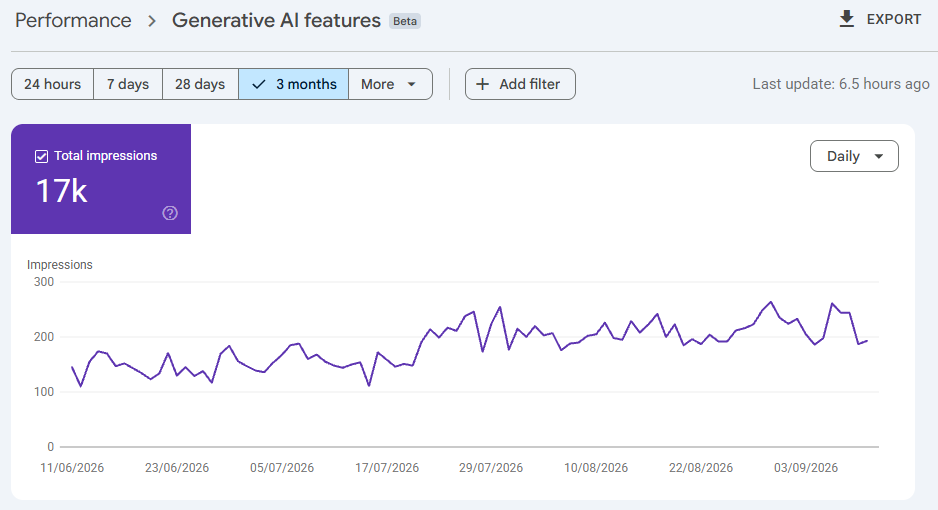
Microsoft introduced AI Performance in Bing Webmaster Tools in public preview in February 2026. It includes citations, referenced URLs, trends and sampled grounding queries across supported Microsoft AI experiences.
These are not simple ranking reports. Use them to see which pages and topics appear, then connect that information with traffic, engagement, enquiries and sales.
Limitations and Risks of AI in SEO
Strategy and Platform Context
AI often follows the direction of a question. That is a problem when the premise needs to be challenged.
Imagine asking how to build a WooCommerce store for 5,000 products when Shopify may suit the operation better. AI can produce a detailed plan and compare both platforms. It cannot take responsibility for the decision.
An experienced consultant should ask: How will stock be managed? Which integrations are essential? Who will maintain the site? Are there complex product rules? Can the business manage hosting, security and updates?
The answer could still be WooCommerce or Shopify. The point is that the request should not dictate the conclusion. Consider the implications for WooCommerce SEO and long-term maintenance before committing.
Accuracy, Privacy and Data Quality
AI can state incorrect information confidently. Verify facts, calculations, links and technical recommendations before publishing or implementing them.
Consider what you upload. Client analytics, customer records and unpublished commercial information may be confidential. Remove unnecessary sensitive details, follow the organisation’s policy and understand how the AI service handles submitted data. UK data-protection responsibilities still apply when AI processes personal information; the ICO provides dedicated guidance on AI and data protection.
Why Automated Fixes Require Human Review
Finding a problem is not the same as choosing the correct fix.
AI may suggest redirecting every 404, but some pages should remain unavailable, some need a relevant replacement and others reveal an internal link that should be fixed at its source. Automated titles may lose important context; valid schema may still misrepresent the visible page.
Safe automation needs limits, backups, testing and validation—especially when an AI agent can act directly on a CMS.
Brand Voice and Original Experience
If your copy could appear on any competitor’s website without anyone noticing, AI has not solved the content problem.
Use real examples, photographs, customer questions, outcomes and informed opinions. AI can polish them, but it should not flatten them into generic marketing language. Your experience is often why the content deserves to exist.
Does Google Penalise AI-Generated Content?
Google does not prohibit content simply because AI contributed to its creation.
Google’s guidance on generative AI content says it can help with research and structuring original content. Generating many pages without adding value may breach its policy on scaled content abuse.
The practical test is not “Was AI used?” Ask instead:
- Is the information accurate and current?
- Does the page satisfy the search intent?
- Does it contain useful detail, experience or evidence?
- Has a knowledgeable person reviewed it?
- Does it add more than a generic summary?
Use AI to organise your thoughts, improve the wording and proofread the copy, and it is acting as a content editor. Publish hundreds of lightly reviewed pages to capture keyword variations, and the risk is the lack of value—not the tool’s name.
AI Tools Versus an Experienced SEO Consultant
AI can automate many repetitive tasks. It does not own the strategy, implementation or outcome.
| Task | What AI can contribute | Where human judgement is needed |
|---|---|---|
| Keyword research | Group large datasets and identify patterns | Validate intent, commercial value and page priorities |
| Content | Outline, draft, edit and reformat quickly | Add experience, verify facts and protect the brand voice |
| Technical audits | Summarise exports and suggest likely fixes | Diagnose causes, assess risk and choose platform-appropriate actions |
| Reporting | Compare datasets and explain discrepancies | Check tracking quality and decide what the business should do next |
| Implementation | Generate code, schema and instructions | Test compatibility, security, accessibility and the final result |
| Strategy | Model options and organise pros and cons | Challenge assumptions, make trade-offs and accept accountability |
That final point matters. Someone must decide what should change, explain why, oversee the work and check the result. AI can help that person work faster; it cannot be accountable to the client.
How I Use AI Within Practical SEO Work
I place AI inside a controlled process rather than let it become the process.
- Identify the Problem
I begin with the business objective and reliable evidence: perhaps a crawl, Search Console data, analytics, a keyword export or a manual review. Define the problem before asking AI for a solution.
- Use AI to Support the Analysis
I provide a focused task and context. For an internal-link review, that includes the exported links, priority pages, site topics and commercial constraints.
- Review and Implement the Solution
I remove irrelevant suggestions and check the rest against the live page, CMS and strategy. Only then are selected changes implemented.
- Check the Result
I recrawl the site, validate code or schema, and monitor Search Console or analytics where relevant. Applying a recommendation is not the same as proving it worked.
This combination—reliable tools, AI-assisted analysis and experienced review—is also how I approach technical SEO consulting.
The Future of AI and SEO
AI is becoming more closely connected to CMSs, analytics platforms and SEO tools. Agents are likely to complete more tasks directly, from updating content to creating redirects.
The important question is not only what AI can do, but what it can be trusted to do safely, with proper permissions and review.
SEO professionals are likely to spend less time moving data and more time framing the right problem, challenging assumptions and taking responsibility for the result.
Frequently Asked Questions
Not fully. It can automate research, drafting and classification, but someone must define the strategy, verify information, manage implementation and remain accountable.
Strong uses include organising keyword sets, analysing internal links, summarising crawl data, reviewing metadata and headings, finding schema opportunities and comparing reports.
It can be, provided it is accurate, useful, original and written for its audience. Publishing unreviewed, generic or mass-produced pages with little value is the risk.
It can generate code and instructions, and connected agents can implement some changes. Unsupervised automation is not appropriate for most sites. Technical fixes should be limited, tested and checked by someone who understands the platform.
Yes. Accessible pages, clear information, internal links, accurate business details and useful content support visibility in conventional and generative search.
Final Thoughts: AI Works Best With Human Expertise
AI is not a shortcut around SEO knowledge. It is a way to apply that knowledge more efficiently: use it to process data, explore options, improve drafts and accelerate implementation, while people remain responsible for context, verification and the final decision.
If you need help deciding where AI can genuinely improve your workflow—and where automated recommendations need a more critical review—explore our SEO services or get in touch.
