

Time is arguably our most important commodity, so anything that saves us time is a winner.
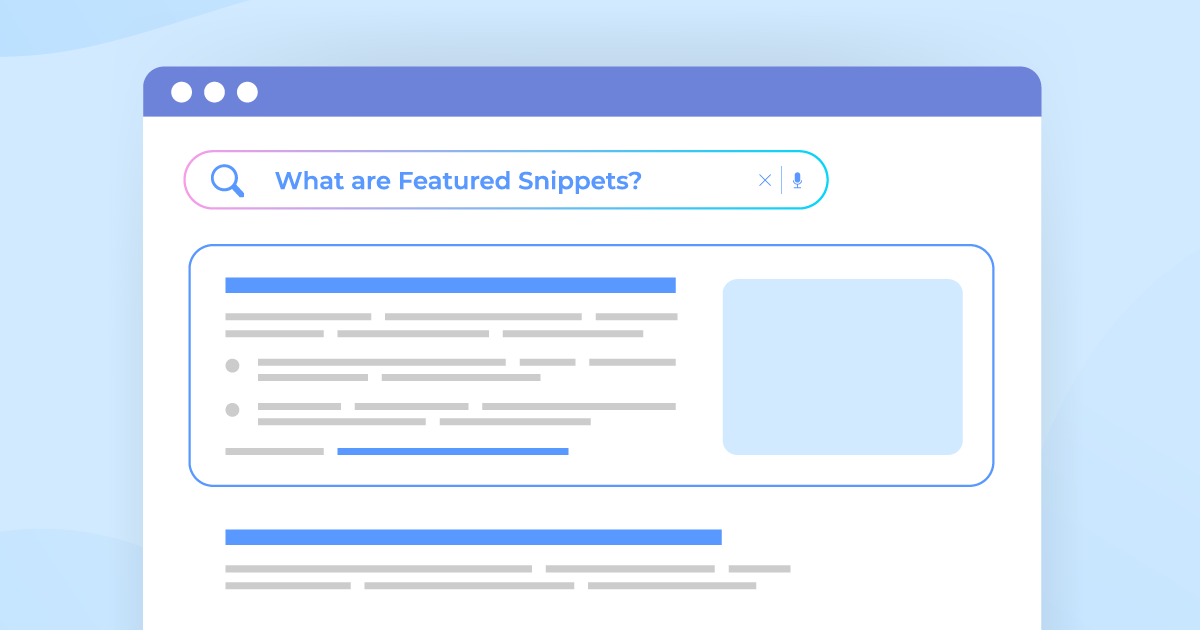
Featured snippets are Google’s way of saving a user time by delivering the exact excerpt of information they are looking for.
If a user searches for ‘Which countries border Germany?’, Google may display a featured snippet containing a concise answer.
This is known as a featured snippet.
This is obviously hugely beneficial to users, but it can also be used to the advantage of website owners and content creators.
What Is a Featured Snippet?
The featured snippet isn’t a response formulated by Google. It’s an extract pulled from a webpage Google has indexed.
The snippet can be taken from any part of a webpage, and it can take the form of a paragraph, a list, a table, or a video.
You can’t create one, as such. The best thing you can do as a content creator is produce content that your audience will find helpful, and keep your fingers crossed that Google selects it as a featured snippet.
According to Google’s featured-snippet documentation, Google automatically decides whether a query would benefit from a featured snippet and which webpage provides a suitable answer.
How Does Google Choose Featured Snippets?
Featured snippets are selected from webpages that Google has crawled and indexed.
Google analyses the content of eligible pages and determines whether part of that content provides a useful answer to the search query. The extract can come from almost any relevant section of the page.
Google may display the information as:
- A paragraph
- A numbered list
- A bullet-point list
- A table
- A video
There is no dedicated featured-snippet schema or submission process. Your content must still be evaluated by Google’s search and ranking systems.
If you are new to search optimisation, our beginner’s guide to SEO explains how crawling, indexing, relevance and rankings work together.
Why Are Featured Snippets Important?
Featured snippets can give a webpage a highly visible position in Google’s search results.
This prominent placement may help a business:
- Attract attention from searchers
- Increase awareness of its brand
- Demonstrate knowledge of a subject
- Generate additional organic clicks
- Reach users searching for specific questions
- Build trust before a visitor enters the website
Featured snippets were traditionally described as “position zero” because they frequently appeared above the standard organic results. However, modern search-result pages contain several different features, and a featured snippet does not always occupy a fixed position.
Earning one also does not allow a page to bypass Google’s ranking systems. Google still selects the content algorithmically.
Traffic is not guaranteed either. A user may click through to learn more, or the featured extract may provide enough information without requiring a visit. Success should therefore be measured through qualified traffic, engagement and conversions—not visibility alone.
Types of Featured Snippets
Google can present featured snippets in several formats. The format normally reflects the type of answer that would be most useful to the searcher.
Paragraph Featured Snippets
Paragraphs are the most common type of featured snippet on Google. In this type of snippet, a whole paragraph will be pulled from a webpage that Google deems to most accurately answer the user’s query. The specific information related to the query will be highlighted or presented in bold to make it easier for the user to scan.

This format is commonly used for searches involving:
- Definitions
- Explanations
- Comparisons
- Reasons
- Short factual answers
- “What is” and “why” questions
For example, a search for “What is technical SEO?” may produce a short definition taken from a relevant webpage.
When targeting a paragraph snippet, place a direct answer immediately below the relevant heading. The answer should be concise enough to scan but detailed enough to address the question accurately.
List Featured Snippets
Featured snippets commonly appear in list form if a query is best answered in numbered steps, or if a bullet-point list makes more sense.
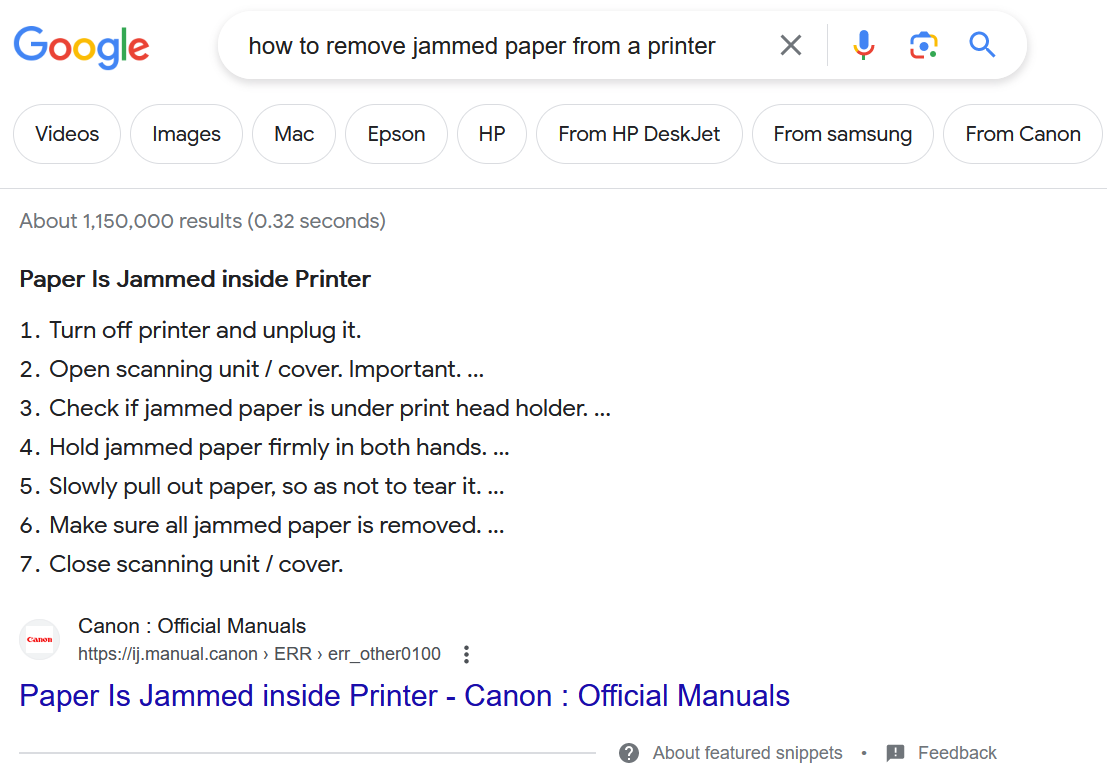
Numbered lists are particularly useful for:
- Step-by-step instructions
- Recipes
- Processes
- Tutorials
- Ranked items
Bullet-point lists work well for:
- Features
- Examples
- Requirements
- Benefits
- Unordered collections
Use proper HTML list elements rather than manually adding numbers or decorative symbols to separate paragraphs. Clear formatting helps readers and search engines understand how the items relate to one another.
Table Featured Snippets
For queries that involve data or comparisons, Google may present a featured snippet in the form of a table. This provides more structured information to the user that’s more efficient to decipher compared with the same information in paragraph form.

This format may be suitable for:
- Prices
- Measurements
- Product specifications
- Dates
- Locations
- Feature comparisons
- Numerical data
Tables should include clear headings and accurately labelled rows and columns. They should also work properly on mobile devices.
Do not force information into a table simply because you want a featured snippet. Use one when it genuinely makes the information easier to compare.
Video Featured Snippets
Videos are becoming increasingly popular as featured snippets, which is no surprise given that YouTube is one of the biggest search engines on the planet. This is particularly relevant for queries related to tutorials and demonstrations.
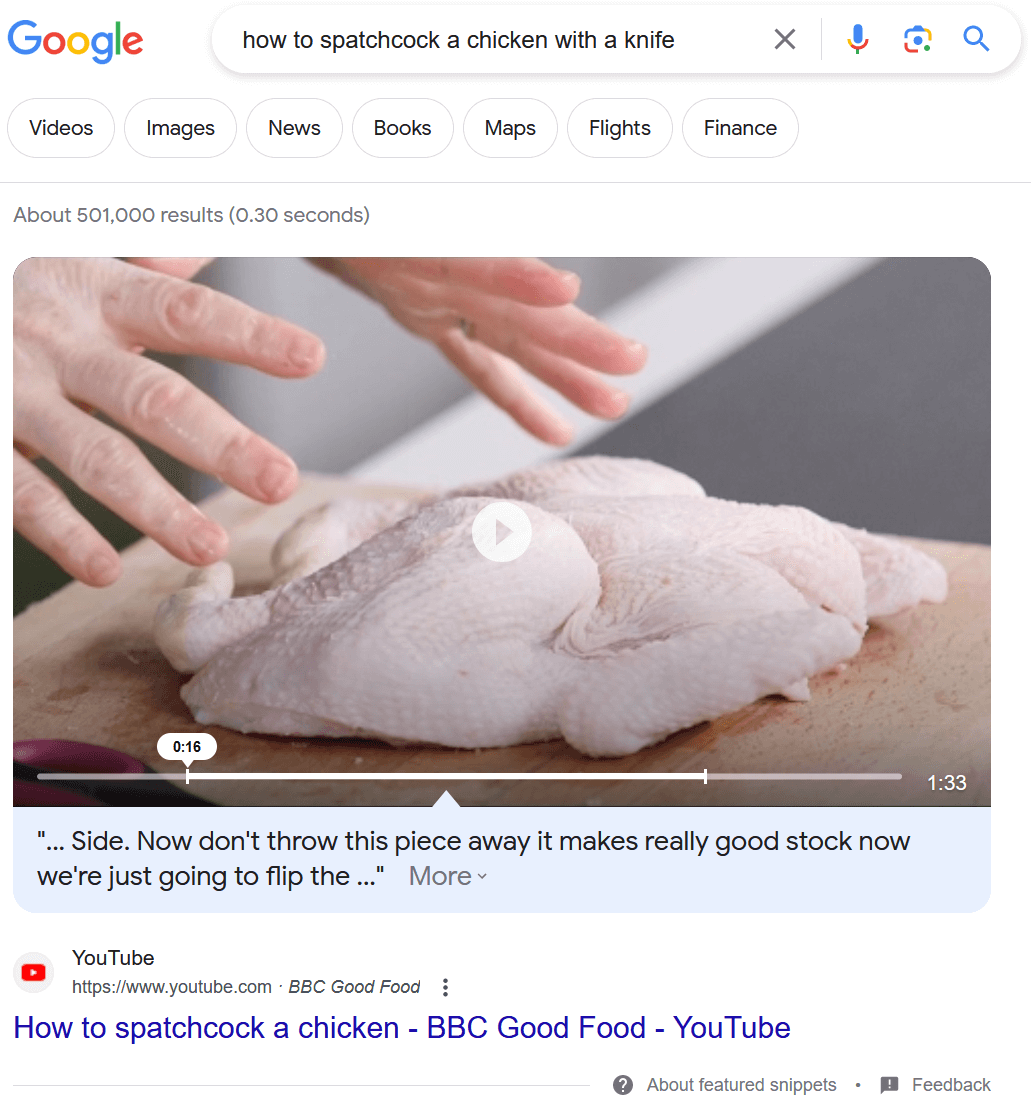
Video results can be valuable for:
- Product demonstrations
- Repairs
- Software tutorials
- Exercise instructions
- Cooking techniques
- Other practical tasks
Use a descriptive video title and explain the important steps clearly. Supporting the video with useful written content can also help search engines and users understand the page.
How to Optimise for Featured Snippets
There’s no quick and easy way to get your content chosen for a featured snippet, but there are ways you can increase the likelihood of this. Consider these recommendations:
1. Find Queries That Display Featured Snippets
Not every search produces a featured snippet.
Before creating or updating a page, search for the target query and inspect the current results. Determine whether Google displays a paragraph, list, table or video.
Search-result features change regularly, so optimisation should be based on current observations rather than old examples.
Begin with questions that are closely related to your products, services or specialist knowledge. Our guide to keyword research explains how to identify topics and queries that matter to your audience.
Specific long-tail keywords can be particularly useful because they often reveal a clear question or problem.
For example, a broad search such as “bathroom taps” could have several possible intentions. A more specific question such as “how do thermostatic shower valves work?” gives the writer a much clearer answer to provide.
2. Answer the Question Immediately
Place the direct answer close to the relevant heading.
Do not make the reader work through a long introduction before reaching the useful information. A short definition or summary can appear first, followed by examples, evidence and further explanation.
This approach also supports better online writing generally. Our content-writing tips explain why readers increasingly expect the main answer early in an article.
The opening answer should be:
- Relevant to the question
- Factually accurate
- Easy to understand
- Free from unnecessary wording
- Detailed enough to be useful
There is no official ideal word count for a featured-snippet answer. Write as much as necessary to answer the question properly, but no more than the reader needs at that point.
3. Match the Format to the Search Intent
Look at the information the user wants and choose the clearest format.
Use:
- A paragraph for a definition or short explanation
- A numbered list for an ordered process
- A bullet-point list for a collection of items
- A table for structured comparisons
- A video when a demonstration is more useful than text
If Google currently displays a numbered list, that can indicate that users benefit from an ordered answer. However, do not simply copy the competing format or wording. Aim to provide a more accurate, complete and useful response.
4. Organise the Page Clearly
Use descriptive headings to divide the article into logical sections.
A good heading should tell the reader what the following section explains. Question-based headings can work well when they reflect the language people genuinely use in searches.
Your page should also use appropriate HTML elements, including:
- One clear H1 for the main title
- H2 headings for major sections
- H3 headings for subsections
- Paragraph elements for written answers
- Ordered and unordered lists
- Properly structured tables
Good structure benefits search engines, accessibility tools and human readers. Our guide to the anatomy of a blog post provides further advice on organising online content.
5. Provide Accurate and Trustworthy Information
Featured snippets aren’t interested in your opinion. They are there to provide concise, accurate answers to a user’s question.
To improve your chances of getting one, be sure to create content that is factual, accurate, and easy to digest. Avoid excessively long sentences, opinions, conjecture, and false claims.
Where appropriate, include:
- Links to primary sources
- Supporting data
- Publication and review dates
- Information about the author
- Relevant professional experience
- Clear explanations of how conclusions were reached
Avoid padding an answer simply to make the article longer. Useful content is not measured by word count alone.
6. Keep the Content Current
Review important articles regularly and correct information that has become outdated or incomplete.
This is particularly important for topics involving:
- Laws and regulations
- Prices
- Statistics
- Software
- Search-engine features
- Product specifications
- Industry standards
Freshness alone does not guarantee a featured snippet. However, outdated information makes a page less useful and can undermine trust.
Display a meaningful “last updated” date when substantial changes have been made. Do not change the date without reviewing and improving the content.
7. Make Sure Google Can Access the Page
Google must be able to crawl and index the page before its content can be considered for a featured snippet.
Check that the page:
- Is not blocked by robots.txt
- Does not contain a
noindexdirective - Loads correctly on mobile devices
- Uses valid and accessible HTML
- Makes its main content visible without requiring user interaction
- Has useful internal links pointing towards it
- Is included in an appropriate XML sitemap
Technical problems can prevent strong content from appearing properly in search. Our technical SEO services focus on crawlability, indexation, performance and website structure.
8. Write Accurate Titles and Meta Descriptions
A descriptive title and meta description can help users understand the page before clicking it.
However, Google does not identify either element as a direct method of earning a featured snippet. The featured extract is normally selected from visible page content.
Continue to optimise titles and descriptions for relevance and click-through rate, but concentrate featured-snippet optimisation on the quality and structure of the answer itself.
Read our guide to essential meta tags or consult Google’s official advice on writing effective meta descriptions.
9. Use Structured Data Correctly
Structured data provides machine-readable information about a page and can make eligible content available for supported rich-result features.
However, Google does not provide a dedicated structured-data type for featured snippets. Adding schema markup does not automatically make a page more likely to receive one.
Use structured data only when it:
- Accurately represents the visible content
- Uses an appropriate supported type
- Includes the required properties
- Follows Google’s policies
- Can be validated successfully
Google explains that correctly implemented structured data makes a page eligible for supported features but does not guarantee that those features will appear. You can learn more through Google’s structured-data documentation and our guide to schema and structured data.
Can You Control Featured Snippets?
You cannot tell Google to select your page for a featured snippet, but you can control how much of your content is available for use in search-result extracts.
Google supports several controls:
nosnippetprevents a textual snippet from being displayedmax-snippetsets a maximum length for a textual snippetdata-nosnippetprevents selected sections of a page from being used
These controls should be used carefully. Restricting the information Google can display may affect how the page appears in featured snippets and other search features.
Full implementation details are available in Google’s guidance on robots meta tags and snippet controls.
How to Measure Featured-Snippet Performance
Use Google Search Console to monitor the page and the queries associated with it.
Review:
- Impressions
- Clicks
- Click-through rate
- Average position
- Queries leading to the page
- Changes following content updates
Search-result features can vary by location, device and time. A controlled manual search or suitable rank-tracking platform can help you record whether a featured snippet is present and which page Google has selected.
Google’s guide to monitoring performance with Search Console explains how to analyse queries, pages and search traffic.
Do not measure success using rankings alone. Determine whether the page attracts relevant visitors and contributes to enquiries, purchases, subscriptions or other meaningful business outcomes.
To Wrap Things Up
Getting a featured snippet is like getting an award of recognition from Google, and it’s certainly something to aspire towards and something to be celebrated when you achieve it.
While there’s no way to guarantee that information from your website will be used as a featured snippet, there are several ways you can boost your chances.
If structured data and meta tags have got your head in a spin, you can alleviate the dizziness by handing over your SEO to a pro.
Contact us to see how we can help.
